By Suzhou Krosino Mechatronic Technology Co., Ltd | 16 March 2026 | 0 Comments
Carbon Fiber Tube Rollers in Labeling Machines: The Lightweight Revolution on Your Production Line
When most people think of carbon fiber, they picture supercars or aerospace parts. Yet the same material that keeps a jet aloft is quietly transforming something far closer to the factory floor: the humble roller inside high-speed labeling machines. In this post we’ll unpack what carbon fiber rollers are, how they’re built, and—most importantly—why they are becoming the go-to upgrade for OEMs and end-users who need faster, more accurate, and more reliable label application.
1. What Exactly Is a Carbon Fiber Roller?
A carbon fiber roller is a thin-walled composite tube made from continuous carbon fibers embedded in an epoxy, vinyl-ester, or thermoplastic matrix. The tube is precision-machined, dynamically balanced, and then fitted with metallic end journals (usually aluminum or stainless steel). Finally, the outer surface receives a functional coating—polyurethane for grip, silicone for release, ceramic for wear, or a conductive layer for static dissipation.
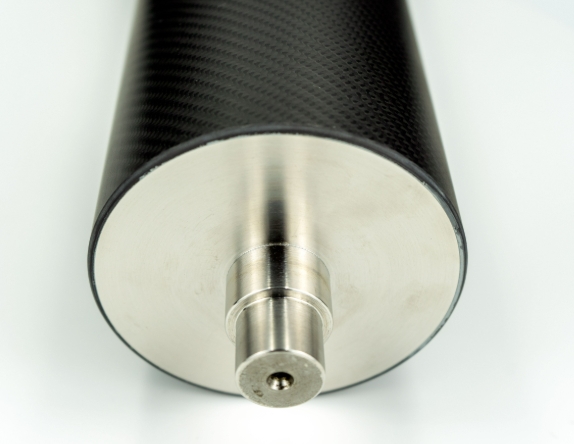
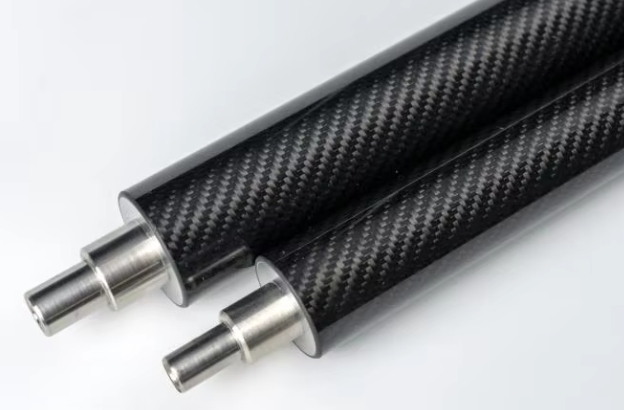
Key properties
• Density 1.6–1.7 g/cm³ (≈¼ of steel)
• Tensile strength 2,000–2,500 MPa
• Elastic modulus 200–240 GPa
• Excellent corrosion resistance and near-zero thermal expansion
2. Why Carbon Fiber Beats Aluminum or Steel
Weight savings translate directly into performance. A carbon fiber roller can cut rotating inertia by 60–70 %. For a labeling machine that starts and stops 20,000–40,000 times per hour, lower inertia means:
• Faster acceleration and deceleration (50–100 ms)
• Smaller servo motors and drives (up to 30 % energy reduction)
• Higher positional accuracy (±20–50 µm) for perfect label placement
• Dramatically reduced vibration and noise (5–8 dB(A) quieter)
3. Typical Applications Across Industries
• Printing & coating: Long, wide rollers stay straight without mid-span deflection.
• Textile & paper: Lighter rollers reduce bearing wear and floor loading.
• Battery film & medical packaging: Inert, clean-room-compatible surfaces.
4. Spotlight: Carbon Fiber Rollers in Labeling Machines
Modern pressure-sensitive, hot-melt, or shrink-sleeve labelers all rely on rollers to:
a) Guide the liner/web
b) Maintain tension during label pick-off
c) Press the label onto bottles, cartons, or pouches
Where carbon fiber makes the biggest impact
• High-speed wrap-around labelers (beer, beverage, pharma vials)
• Top/bottom or front/back sticker applicators on flexible pouches
• Rotary in-mold labeling (IML) systems for thin-wall containers
Case study numbers
• 500 mm long, 80 mm OD carbon fiber guide roller replaces aluminum:
– Weight drops from 3.2 kg to 0.9 kg
– Critical speed rises from 2,800 rpm to 4,500 rpm
– Label placement repeatability improves from ±0.5 mm to ±0.1 mm
– Annual energy savings: ~€1,200 per machine (24/7 operation)
5. Surface Engineering for Labeling Challenges
• Anti-static carbon black or metallic coating prevents label “double-feed” in dry climates.
• 60–80 Shore A polyurethane sleeve adds grip without marring clear-on-clear labels.
• FDA/EU food-grade silicone sleeves withstand 150 °C for hot-melt glue stations.
• Ceramic plasma coatings give 5× wear life when abrasive UV inks are present.
6. Installation & Maintenance Tips
• Specify tapered roller bearings with internal clearance C3/C4 to compensate for thermal expansion mismatch between carbon tube and steel shaft.
• Torque end-journal screws to 80 % of the composite supplier’s recommended limit—over-torquing crushes the tube.
• Inspect surface coating every 6–12 months; re-coat rather than replace the entire roller to cut life-cycle cost by ~50 %.
7. ROI Snapshot
A carbon fiber roller typically costs 2–3 × an aluminum equivalent, but payback arrives in 6–12 months through:
• Higher line speed (+15–25 %)
• Fewer rejects (-30 %)
• Lower energy and maintenance bills
• Longer bearing life due to reduced dynamic loads
8. Looking Ahead
As linerless labels, RFID smart labels, and ultra-thin films push machines to 600+ labels per minute, carbon fiber rollers will evolve:
• Embedded RFID for predictive maintenance
• Hybrid thermoplastic recyclable cores
• In-line eddy-current inspection to detect delamination before failure
Switching to carbon fiber rollers isn’t just a materials upgrade—it’s a systems-level performance boost. If your labeling line is bumping into speed or accuracy limits, the lightest roller in the plant might be the heaviest contributor to your next productivity leap.
Suzhou Krosino Mechatronic Technology Co., Ltd: Innovations in Precision Manufacturing
Suzhou Krosino Mechatronic Technology Co., Ltd: Innovations in Precision Manufacturing
Leave a Reply
Your email address will not be published.Required fields are marked. *